.png)

.png)
The American Woman Who Conquered British Rock
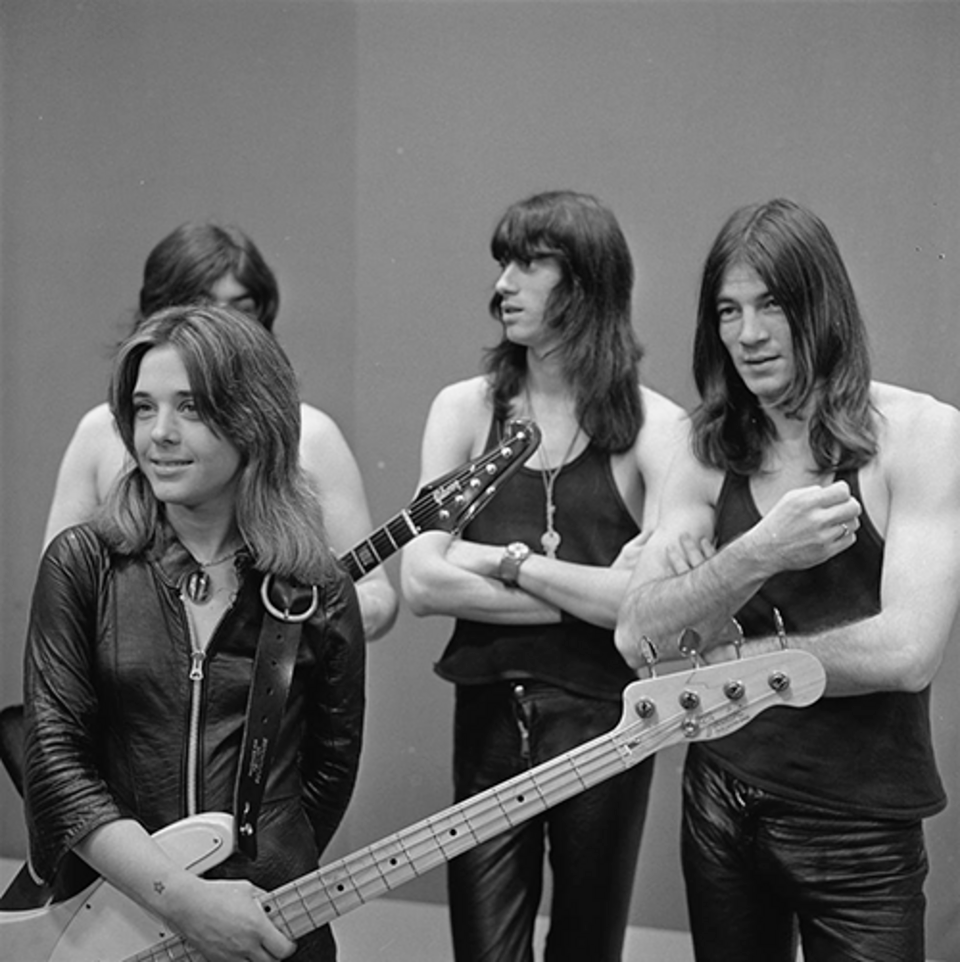
Suzi Quatro was an all-American rock star… but she never took off state-side. So why did Europe fall for her so hard?
Suzi was born in the city that seems to spawn great musicians like no other - Detroit, Michigan. She was one of 5 kids, and they were all musical. Her dad was a multi-instrumentalist, and his children seemed to inherit his passion for music.
When she was 14, Suzi’s older sister Patti roped her into joining her band, called The Pleasure Seekers. Patti told Suzi she would be playing bass, which turned out to be a match made in heaven and became her instrument of choice throughout her career.
It wasn’t long before Suzi became the lead vocalist for the Pleasure Seekers.
This was their track What a Way to Die from 1965, with Suzi on bass and vocals. You can see why they soon became pretty popular on the local scene, they put so much energy into their songs.
By 1967, a local promoter gave the girls a very interesting offer… they would be given a free holiday in Hawaii, if afterwards, they agreed to fly over to Vietnam and play to the American troops there.
Now Suzi was always pretty daring, and she was more than happy to travel into a war zone if it meant an opportunity to travel out of the US for the first time. So, the band agreed, and after an other-worldly time in Hawaii, they flew to Vietnam. She told the Sunday Times in 2024:
“This was the first time I’d left America and it was like floating through a crazy dream: outside it was all blue skies, white sand, palm trees and beautiful sunsets, but in the hospital we saw men who’d lost eyes, legs, arms — young kids, just like us.”
That sight would make anyone grow up fast, but it didn’t put Suzi off travelling. In fact, you could argue she had well and truly been bitten by the travel bug.
A few years later, Suzi’s brother heard there was a famous record producer in town by the name of Mickie Most. He had just set up his own record label called RAK records. Mickie Most was a pretty big deal. He had worked with acts like The Animals, Herman’s Hermits, Lulu, Donovan, and Jeff Beck. And he’d go on to work with a lot more legendary names in the business over the years.. When Suzi’s brother realised what an opportunity this could be, he tracked him down and convinced Mickie to watch Suzi perform live.
Most was very impressed with her talent, signed her to a solo deal and brought her back to the UK.
At this time, by the way, Pleasure Seekers had morphed into a new band called Cradle and they were seeing some minor success, but they never really broke through in the way Suzi was hoping they would. But here was Mickie, offering her the opportunity of a lifetime, so, aged just 21, she took it.
Now that’s not to say she found it easy to move so far away from her family and friends. In fact, at first she found it incredibly difficult. She told the Sunday Times:
“I tried to imagine that I was on holiday, but I missed my home and family and cried myself to sleep every night. That was the one time when travelling caught me off-guard, but it didn’t last because I acclimatised.”

So, by the end of 1971 Suzi was in a recording studio in London.
Her first single was called Rolling Stone.
Rolling Stone really speaks of her chasing her independence and is very autobiographical. But for whatever reason it just didn’t take off. On top of that, the band she had hired joined her for one disastrous gig, so much so that she immediately had to go back to the drawing board.
She kept Keith Hodge as her drummer, but hired Len Tuckey on guitar and Alastair McKenzie on keyboard. In November 1972, they secured a spot supporting the legendary glam rock band Slade on tour, and it was here that they really started to develop together as a band.
On top of that, Mickie Most pulled in the big guns - the hit-making powerhouse that was songwriters Nicky Chinn and Mike Chapman. They worked their magic, and in May 1973 the single Can the Can hit the airwaves across the UK and reached Number 1.
You can see why it struck a chord. So catchy.
Something a bit Status Quo-y about the instrumental, but Suzi’s vocals really cut through it all.
This single also landed them a spot on the UK’s biggest music show - Top of the Pops (at this point,by the way Dave Neal had replaced Hodge on the drums). Suzi performed in a leather cat suit, plucking her bass while simultaneously pulling off some amazing vocals… the nation, quite rightly, fell in love.
Her debut album was released in 1973. It performed pretty well in the UK and very well in Europe.
Her singles throughout 1973 and 74 though, cemented Suzi a spot in the music consciousness of the UK, Europe, and Australia. 48 Crash, Daytona Demon and Devil Gate Drive all performed well.
However, despite performing exceptionally well in the UK and Europe, her songs weren’t having any impact on America whatsoever. Her best performing single, Can The Can only reached number 56. In fact, she wouldn’t break the top 40 in America until 1978 - 5 years after her debut. And even that was a duet.
That’s not to say she hadn’t tried to break America - she joined Alice Cooper on tour around the US, hoping to push her music there. But the needle didn’t budge.
Over the next few years, Suzi’s success was a bit sporadic in the UK. The next 3 albums, Quatro, Your Mama Won’t Like Me and Aggro-phobia did fairly well in Europe but didn’t chart in the UK. That didn’t seem to matter though, she had built a very loyal fanbase.

She toured constantly, maintaining her dedicated fans across Europe and Australia. However, she was reluctant to fall into the stereotype of a typical rock star on tour in the 70s. She said in the same interview:
“The whole sex, drugs and trashing the hotel room thing has never been me. I’d get friendly with the hotel staff then feel bad if one of my band wanted to throw the TV out the window, yelling: “Don’t you dare! Someone will have to clear up your mess.””
It should be said here just how influential Suzi Quatro was for women in rock music. She’s widely celebrated as the first female rock star to lead a band while simultaneously playing an instrument.
She shattered the 70s rock industry standard that women in popular music could only be vocalists, opening the gates for generations of female artists by playing electric bass and rocking just as hard as her male counterparts. She inspired a new wave of female-led punk and rock acts - Joan Jett, Chrissie Hynde, Kathy Valentine and Tina Weymouth to name a few.
Anyway, she was riding this wave of success for a few years, but struggled to recreate the heights of the first few singles for a little while.
But she seemed to have a second wind in the late 70s.
In 1978, she released the single If You Can’t Give Me Love.
As you can hear from that clip, this song was a lot more mellow than her early stuff, and this evolution seemed to serve her well. Once again, it was a hit across the UK, Europe and Australia.
Then, later that year, as I touched on earlier, she did a duet with Chris Norman of the band Smokie called Stumblin’ In. This was her first time seeing some real success in the US - it reached No. 4.
Just from listening to that short clip you can see why it appealed a bit more to the American audience. It has a very smooth sound and their voices work really well together.
However, that would be the only hit in the US for Suzi. But why? Why did she not catch on in the states, despite being from there herself?
Well, a big part of it was her style of music. When Mickie took her to England, she was immersed in the European glam rock scene, something that didn’t always translate well to US radio. You could simply argue that there were different trends happening in the US and Europe at the time - hence why Stumblin’ In did so well in America despite being very different to her usual style of music.
Another theory is that she failed to find success in the US music industry because she had found more success in another US industry… Television.
In 1977 Suzi joined the cast of the incredibly successful show Happy Days, playing the character Leather Tuscadero across 7 episodes. So she was a household name in many American households, but not for the same reason that she was in British households.
Some fans theorise this role type casted her for many American fans as an actress rather than a musician, so her music career never took off in the same way.
Whatever the reason, there’s no denying that Suzi Quatro was a trailblazer in European rock, especially when it came to challenging stereotypes about women in the scene.
If you would rather watch these stories than read them, check out my YouTube channel!


Comments