.png)

.png)
The twisted history behind the Stooges

I knew the Stooges had a bit of a weird story behind them, but while researching their history, I had no idea just how twisted and messed up it really was.
The concept of the Stooges was inspired by a musical pilgrimage to England. Future guitarist Ron Asheton and bassist Dave Alexander hopped on a plane in 1965, hoping to meet the Beatles.
Sadly, their dream of bumping into John Lennon in a local pub never came to fruition, but they did take the opportunity to visit some of the iconic venues where the Beatles had played.
One of these venues was the Cavern Club in Liverpool, and it was there that they had their first taste of the local music scene. They found the bands incredibly inspiring and wanted to start one of their own.
During their trip, they also saw the Who live. The band were around the time of releasing My Generation, and Asheton and Alexander were mesmerised.
Asheton later recalled the experience in an interview with Classic Rock:
“Townshend was really feeling great [...] He broke his Rickenbacker on stage that night, and my friend ran up and got me a little piece of it.”
Eventually, the pair ran out of money and had to return to America, but that little souvenir served as a huge motivator for Asheton. They were going to start a band.
Once they returned to Michigan, they recruited Asheton’s younger brother, Scott, on drums and began practising. There was just one problem: they were a bit rubbish.
They needed someone with more musical experience to help organise them, and they had just the person in mind.
Jim Osterberg, later known as Iggy Pop, had attended the same school as the others and was known for his musical talent. He was a great drummer, so they approached him, hoping he would be willing to teach Scott.
Before they knew it, the three-piece had become a four-piece, with Osterberg’s work ethic making them a little more serious. The other three would often be persuaded to practise with the promise of drugs, and they soon became a force of nature.
It was around this time that they settled on their first name: the Psychedelic Stooges. The Asheton brothers had long been fans of the comedy trio the Three Stooges and felt they could relate to being society’s oddballs. They added “Psychedelic” because they had been on acid that day. Things were much simpler back then…
It wasn’t long before they had their first opportunity to perform: a Halloween house party in 1967. Although it was a small affair, it certainly stuck in people’s minds.
At this stage, the band couldn’t afford proper instruments, so they got creative over the course of their first few gigs.
Osterberg played Hawaiian guitar but also introduced his own homemade instruments, including a vacuum cleaner and a blender. Meanwhile, Scott Asheton pounded away at an oil drum.
According to reports, the sound was… unique. Unfortunately, there don’t appear to be any recordings, but people who were there at the time have described much of their set as sounding like a plane taking off.

Despite this shaky start, they managed to secure regular gigs. One venue in particular was Detroit’s Grande Ballroom, now known as one of the birthplaces of American punk. Fellow Michigan legends MC5 also played there regularly over the years.
The Stooges were part of that same scene, and it was actually MC5’s manager who recommended them to a promoter at the Grande Ballroom.
One particular appearance by the Psychedelic Stooges helped raise their profile. They were supporting Blood, Sweat & Tears, and I highly doubt the audience were prepared for what they were about to witness.
Not only were the band still using their makeshift instruments, but Pop came onstage wearing a maternity dress, clown make-up and a tinfoil hat.
By this stage, Ron Asheton and Alexander had acquired a guitar and bass, respectively. Unfortunately, this didn’t help much when Alexander became so high that he forgot how to play.
Somehow, they avoided being booed offstage. Perhaps the audience were simply too bewildered to know how to react.
Over time, the band transitioned to conventional instruments, but they always had one thing in mind: being unique.
Asheton later explained to Classic Rock:
“We wanted to do something different, and we just went in our own pace [...] We put aside normal instruments and then made up our own stuff. After a while we started picking up regular instruments and guitars. It was just simple music, just what came out of us naturally.”
During these early days, the band also began living together. The house was probably much as you might imagine: a complete mess, with mould growing in the kitchen and regular visits from a travelling shaman who would perform ceremonies in exchange for weed. Nevertheless, it served as the band’s creative hub during their first few years.
Over the course of 1968, the band attracted the attention of record label Elektra. By 1969, their live performances had become even weirder, if that was possible, and, to be honest, considerably darker.
One example was a gig at a university in Ohio. At one point, Pop picked up a shard of a broken drumstick and began running it across his chest, continuing until he started bleeding.
He was also fond of indecent exposure and, on occasion, had a rather questionable encounter with an amplifier. The less said about that, perhaps, the better.
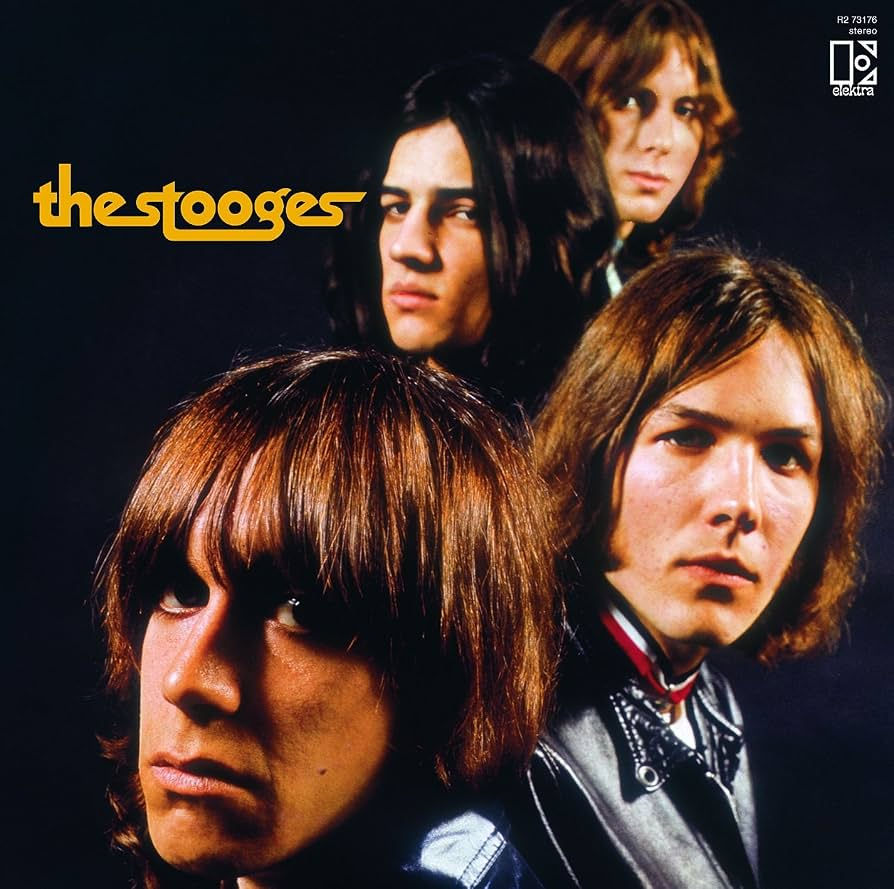
By the summer of 1969, the band were making their first album. They dropped “Psychedelic” from their name and became simply the Stooges.
Their self-titled debut showcased their sound perfectly, featuring heavily distorted guitar, minimal chords and sneering vocals. “I Wanna Be Your Dog” is a perfect example.
The album gave the world a glimpse of what was to come. They hadn’t quite perfected the sound that would make them pioneers of punk rock, but they were certainly finding their feet.
The album was written and recorded quickly, following a white lie they had told an Elektra representative who asked whether they had more than four songs. They didn’t, but within the next five days, they had written an entire album.
At the time, they had no idea that it would help lay the groundwork for the American punk scene. Nevertheless, it gradually brought them greater public attention.
Within a few years, bands such as the Ramones and the Sex Pistols would cite the Stooges as a major influence.
Their next album, Fun House, took things further. It captured their chaotic, raw live sound and was even more proto-punk than their debut. They were beginning to settle into their aggressive, punk-inflected style, and the track “1970” is a perfect example of its speed and energy.
Shortly after the album’s release, Dave Alexander was fired from the band after turning up at a music festival too intoxicated to perform. He would never re-join the group and sadly died from complications related to alcoholism at just 27, joining the infamous “27 Club”.
By the time the band recorded Fun House, most of its members, apart from Ron Asheton, had developed severe heroin addictions. These were having a profound effect on both their personal and professional lives. They reportedly sold their own instruments to fund their habits, while their live performances became increasingly erratic and unhinged.

The band struggled to hold basic riffs together, and frontman Iggy Pop often had difficulty standing up onstage.
Things became so bad that Elektra dropped them in 1971, partly because of the poor sales of Fun House. The band soon broke up, but the split didn’t last long.
They signed a contract with Columbia Records and were back together by 1972. This time, they were rebranded as Iggy and the Stooges, and Ron Asheton had been moved from guitar to bass, a change he was unhappy about.
They released Raw Power, produced by David Bowie, who had become great friends with Pop around this time.
The album had a much harder rock sound, and many regard it as one of the most influential records in laying the groundwork for American punk. By this point, the band had well and truly found their sound.
All the while, their wild live performances continued to bolster their reputation for being completely unhinged. Some people hated them, while others loved the shock and danger they brought to the stage.
At one gig in Cincinnati in 1970, Pop produced a jar of peanut butter and began smearing it across his chest before hurling it into the audience. One can only hope nobody had a peanut allergy.
On another occasion, he launched a slice of watermelon into the crowd with such force that it reportedly gave a woman a concussion.
However, the performances stopped being fun and started becoming downright frightening by 1974. The band were still heavily involved with drugs, and Pop, in particular, was becoming increasingly erratic offstage as his heroin addiction worsened.
Columbia also dropped them after Raw Power failed to sell well, and in February 1974, the band broke up again.
But Iggy wasn’t finished.
Pop continued pursuing a solo career, and his first performance outside the Stooges has gone down in music history as one of the strangest and most unhinged shows of all time. It took place in Los Angeles and was called The Murder of a Virgin.
Wild rumours had been circulating for some time that Pop planned to kill himself onstage. Some stories claim he demanded a million dollars from promoters to do it, which seems rather ironic. Perhaps that was the point.
Whatever the truth, Iggy was a loose cannon when it came to live performances. Nobody really knew what he might do next, particularly when he announced a show with such an ominous title.
This story is surrounded by controversy. Many established biographies do not mention it, and the available accounts are difficult to verify, so it is impossible to say with certainty how much of it is true.
According to one version, Pop asked the audience, “Do you want to see blood?” His guitarist, dressed as a Nazi, then whipped him until he bled.
The story goes on to claim that Pop shouted racial abuse at the audience, hoping someone would become angry enough to stab him with a knife he had brought onstage. When nobody took the bait, he allegedly carved an X into his own chest.
Again, it is difficult to establish whether these events happened exactly as described. But that is one of the strange things about rock and roll: stories become embellished, and people and events are gradually transformed into myths. It is all part of the mythology surrounding the music.
With his solo career going nowhere and his heroin addiction worsening, Pop eventually decided to enter rehabilitation in the mid-1970s.
And David Bowie, being the supportive friend he was, apparently decided to smuggle drugs into the hospital for him.
Bowie recalled the incident in Blender magazine in 2002:
“This was very much a leave-your-drugs-at-the-door hospital. We were out of our minds, all of us. He wasn’t well; that’s all we knew. We thought we should bring him some drugs, because he probably hadn’t had any for days!”
It wasn’t long before Bowie recognised the extent of his own addiction and his unhappiness in Los Angeles. The pair eventually escaped to Berlin together, where they sought to get their lives back on track.
The result was some remarkable music, including Bowie’s famous Berlin trilogy and Pop’s solo albums The Idiot and Lust for Life, both produced by Bowie. These records finally helped launch Pop into a successful solo career.
Pop eventually managed to overcome his drug addiction completely.
As for the Stooges, they eventually reunited in 2003. They released another album, The Weirdness, in 2007, but Ron Asheton sadly died in 2009.
Without him, the Stooges released one more album, Ready to Die, in 2013, before Scott Asheton also died in 2014.
Now approaching 80, Iggy Pop is the only surviving member of the original line-up. Quite how he survived the decades of excess is difficult to comprehend. Perhaps he made some sort of extraordinary deal with the devil.
Whatever the explanation, he is still performing live, although he is perhaps not quite as unhinged as he once was.
The Stooges may have been chaotic, confrontational and, at times, genuinely disturbing, but their influence on punk rock is undeniable. Their music helped shape a genre that would go on to transform popular music, and their reputation for unpredictable performances has become almost as legendary as the records themselves.
If you would rather watch these stories than read them, check out my YouTube channel!



Comments